Does Reverse Osmosis Remove Microplastics?
Yes — and to a very high degree. Reverse osmosis is one of the most effective technologies available for removing microplastics from drinking water. Here's what the research shows.
Find out your current exposure level
15 questions · 2 minutes · based on peer-reviewed science
How reverse osmosis works
Reverse osmosis (RO) forces water under pressure through a semi-permeable membrane with pore sizes typically in the range of 0.0001 microns (0.1 nanometres). To put this in context, the smallest microplastic particles that researchers routinely detect are around 1 micron — roughly 10,000 times larger than an RO membrane pore. Even nanoplastic particles, which are far smaller than microplastics, are typically 100–1,000 nanometres in size, still orders of magnitude larger than what passes through an RO membrane.
This size mismatch is why RO is so effective. It is not relying on chemical affinity or adsorption — it is a purely physical barrier that microplastic and nanoplastic particles simply cannot pass through.
What the research shows
A 2023 review by Cherian et al. in Polymers assessed multiple filtration technologies against microplastic removal efficiency. The review found that reverse osmosis consistently achieved removal rates above 99%, outperforming all other common household filtration methods including activated carbon filters, ultrafiltration, and sand filtration. The near-complete removal was attributed to the membrane pore size being orders of magnitude smaller than even the smallest detectable microplastic particles.
Acarer (2023) in Water Science and Technology reviewed removal efficiencies across conventional and advanced water treatment processes, confirming that membrane-based technologies — particularly RO and nanofiltration — provide the highest and most reliable microplastic removal. Conventional water treatment (coagulation, sedimentation, sand filtration) removed 40–80% of microplastics, while membrane processes consistently achieved 99%+ removal.
How does it compare to other filters?
Tang and Hadibarata (2021) in Environmental Challenges reviewed a range of microplastic removal technologies and found a clear performance hierarchy:
- Reverse osmosis: >99% removal — the highest of any household technology
- Ultrafiltration membranes: 85–99% — effective but less thorough than RO
- Activated carbon block filters: 70–90% for larger particles — less effective for particles below 10 microns
- Standard pitcher filters (Brita-style): Variable — may remove larger particles but inconsistent for smaller ones
- Boiling tap water: 80–90% for hard water (as per Yu et al. 2024) — free and highly accessible
- Bottled water: Adds microplastics rather than removing them — not a solution
Does RO remove nanoplastics too?
This is where the evidence is more limited. Nanoplastics are defined as particles below 1 micron, though in practice researchers often use a threshold of 100 nanometres. The membrane pore size of a standard RO system (0.0001 microns = 0.1 nm) is still smaller than even the smallest nanoplastics measured in studies. On theoretical grounds, RO should remove nanoplastics with similar efficiency to microplastics.
However, the measurement challenge is significant: nanoplastics are extremely difficult to detect and quantify reliably, so few studies have directly measured RO removal rates for nanoplastics specifically. The physics strongly supports high removal efficiency, but peer-reviewed confirmation at the nanoscale is limited.
Practical considerations
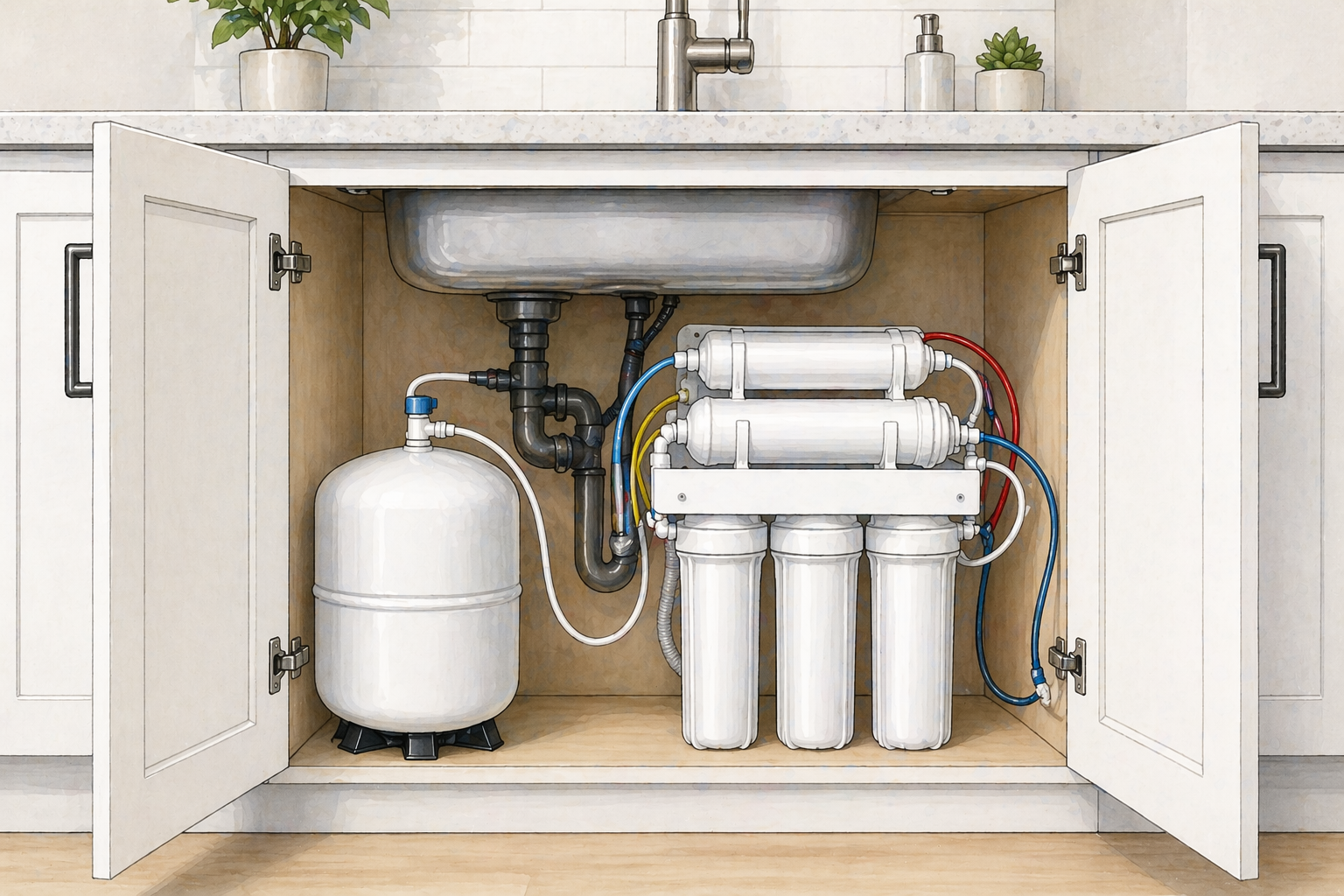
RO systems are effective but come with trade-offs. They waste water — a typical household RO unit produces 3–4 litres of waste water for every litre of filtered water, though more efficient models are available. They also remove beneficial minerals including calcium and magnesium, which some users remineralise back in. Countertop and under-sink systems are both available; under-sink systems with a storage tank are more convenient for daily use.
For most households, the choice between RO and a quality activated carbon block filter (such as those from Berkey or ZeroWater) comes down to cost versus performance. An activated carbon block filter at ~£50–150 removes 70–90% of microplastics. RO removes >99% but costs more to install and maintain, and wastes water. Both are dramatically better than bottled water or no filtration.
The bottom line
Yes, reverse osmosis removes microplastics — to a higher degree than any other readily available household water treatment technology. If reducing microplastic exposure from drinking water is a priority, RO is the most evidence-backed approach. For those who find RO impractical, boiling hard tap water (Yu et al. 2024) or using an activated carbon block filter are meaningful alternatives supported by published research.
Find out your personal exposure
15 questions · 2 minutes · peer-reviewed science
Start the calculator →References
- Cherian AG et al. A Review of Microplastics in Water: Occurrence, Fate, and Removal. Polymers. 2023. DOI: 10.3390/polym15061331
- Acarer S. A review of microplastic removal from water and wastewater by membrane technologies. Water Sci Technol. 2023. DOI: 10.2166/wst.2023.186
- Tang KHD & Hadibarata T. Microplastics removal through water treatment processes: a critical review. Environ Challenges. 2021. DOI: 10.1016/j.envc.2021.100264
- Yu Z et al. Drinking Boiled Tap Water Reduces Human Intake of Nanoplastics and Microplastics. Environ Sci Technol Lett. 2024. DOI: 10.1021/acs.estlett.4c00081